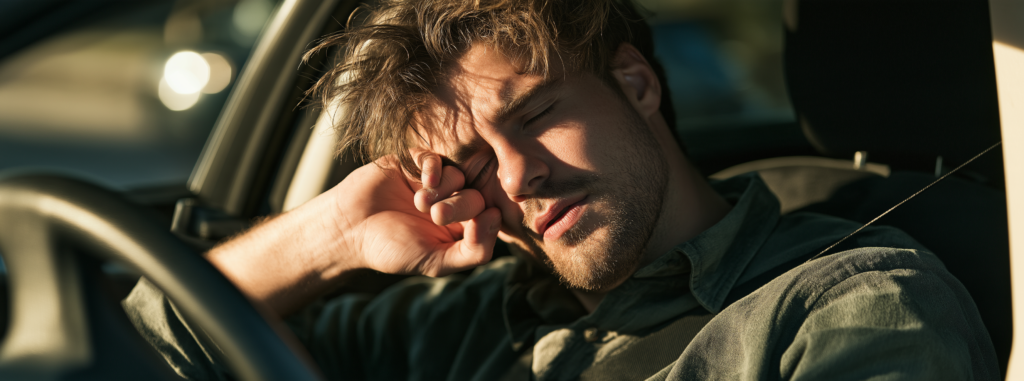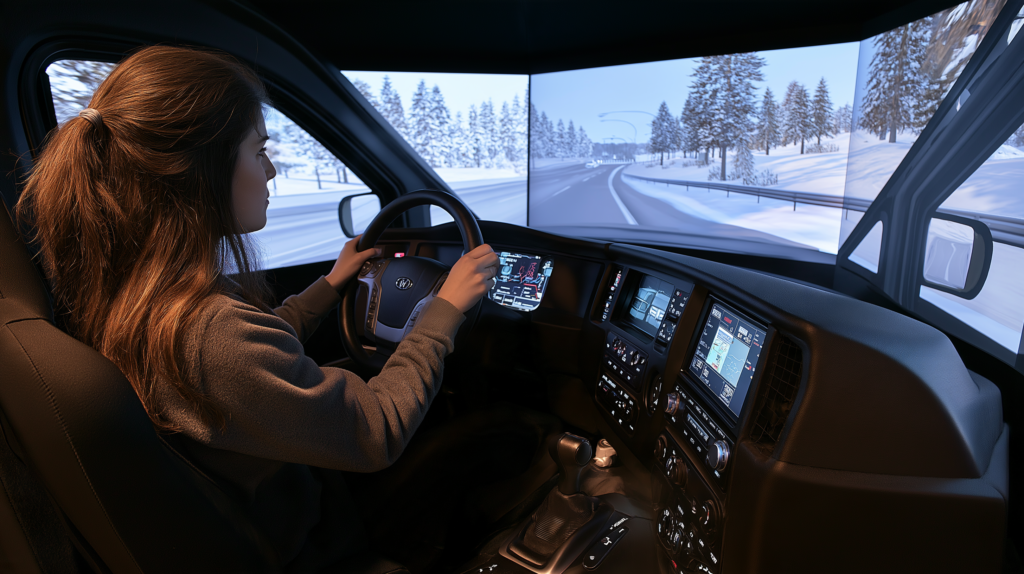
Every five minutes, a tester asks a drowsy driver a question: How sleepy are you, on a scale of 1 to 9? The driver answers. For the next few minutes, they are less sleepy.
Optalert has now reviewed drowsy-driving data from many leading tier-1 and tier-2 automotive suppliers. We regularly see the same pattern in the Johns Drowsiness Scale (JDS): A drop in drowsiness after every question, then a slow climb back up. The erroneous method used to measure drowsiness is changing the drowsiness it measures.
That is a problem for anyone building a ground truth. It is also a clear demonstration of how sensitive the JDS is: It detects the alerting effect of a single question.
How drowsiness data is usually collected
Most drowsy-driving studies use the Karolinska Sleepiness Scale (KSS) as their reference. The KSS is a 9-point self-rating, from 1 (extremely alert) to 9 (very sleepy, fighting sleep). A tester asks the driver for their rating at fixed intervals, usually every five minutes.
There is a reason for this. The EU General Safety Regulation’s requirements for driver drowsiness and attention warning (DDAW) systems, set out in Delegated Regulation (EU) 2021/1341, use the KSS as their reference scale. A DDAW system must warn the driver at KSS 8 or above. Asking for KSS ratings during testing looks like the most direct way to show compliance.
The question is a countermeasure
Asking a drowsy person how sleepy they are wakes them up. To answer, the driver has to assess how they feel and then speak. Two-way conversation is one of the most effective countermeasures to drowsiness, so every KSS prompt is a small intervention.
Real driving does not work like this. A truck driver on a long, open stretch of road does not talk to someone every five minutes. A test that interrupts the driver this often is no longer measuring the naturalistic drowsiness a driver monitoring system (DMS) has to detect on the road.
What the JDS shows
The JDS measures drowsiness from 64 mathematical parameters derived from eyelid movements. Plotted across a drive with KSS prompts, we regularly see it form a sawtooth.
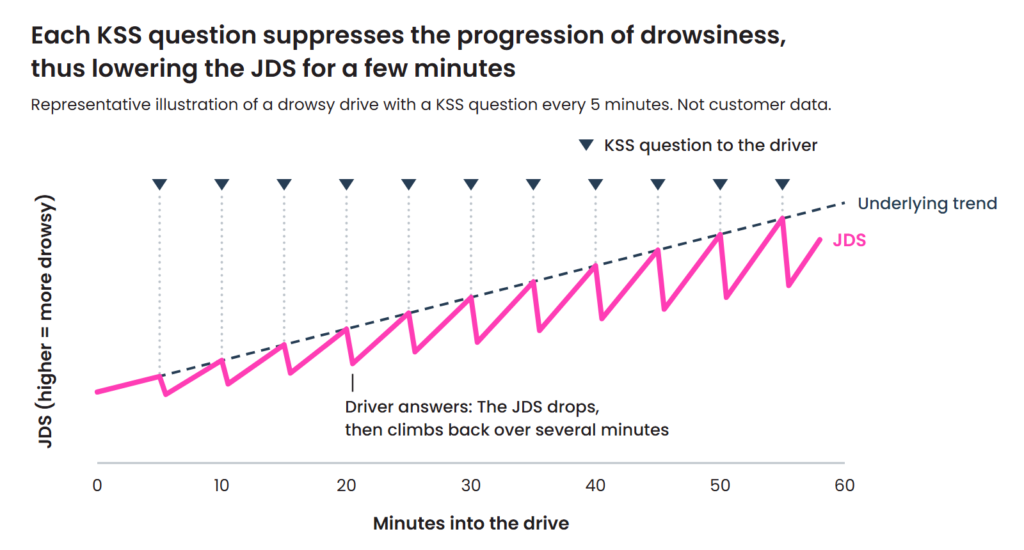
After each question, the JDS drops. Over the next few minutes it climbs back, and each peak sits higher than the last. The question buys a few minutes of alertness but does not remove the sleep pressure underneath, so drowsiness returns.
The dip is not an artefact of the driver speaking. It lasts several minutes, well beyond the few seconds it takes to answer.
The chart in this article is a representative illustration of the pattern we see. Optalert cannot publish customer data.
Why this matters for drowsiness data
Repeated prompts change the dataset in four ways:
- The data no longer reflects natural drowsiness. Every five minutes, the driver gets a small dose of alertness. Every signal recorded during the drive, including the DMS output being validated, comes from a driver who is repeatedly roused.
- Drowsy episodes are cut short. A driver who is woken every five minutes spends less time in deep drowsiness. Studies need longer drives to capture the high-drowsiness events a DMS must detect, and may still miss them.
- The DMS is tuned to an artificial pattern. Thresholds and algorithms developed on this data learn from a driver who is regularly interrupted, not a driver alone on a long road.
- The reference itself is less accurate. The KSS measures how tired someone feels. The JDS measures objective impairment. The two have a linear relationship, but they sometimes decouple. When they do, it is usually the KSS that is wrong: The driver’s self-assessment is out of line with their actual level of impairment.
What it says about the JDS
One short question to the driver produces a change in the JDS that lasts minutes. The JDS is sensitive enough to detect the alerting effect of a single conversation.
That sensitivity matters on the road. A system that reacts only once the eyes start to close detects drowsiness when it is already dangerous. The JDS tracks drowsiness as it builds, so it can warn earlier. It also shows whether a countermeasure, such as a conversation or a rest break, has worked and for how long.
A better approach: passive data collection
Optalert recommends that drowsy-driving data collection involves no interaction with the driver. A naturalistic test should mimic real driving and detect drowsiness passively.
Use objective impairment, such as lane departures or the JDS, as the ground truth.
This does not put compliance at risk. Delegated Regulation (EU) 2021/1341 allows alternative measures to the KSS where their validity is shown. Four leading European technical services recognise the JDS as a valid alternative measurement under the regulation. In addition, it measures objective impairment more accurately than a self-rating.
Automakers can meet the regulation and achieve top Euro NCAP ratings without asking drivers for KSS ratings during testing. As a bonus, the resulting system will sound fewer false alerts to the delight of customers.
Talk to Optalert about your next study
Optalert works with automakers and tier-1 and tier-2 suppliers on DMS development and validation. If you are planning a drowsy-driving study, or want a second look at data you have already collected, contact our team.