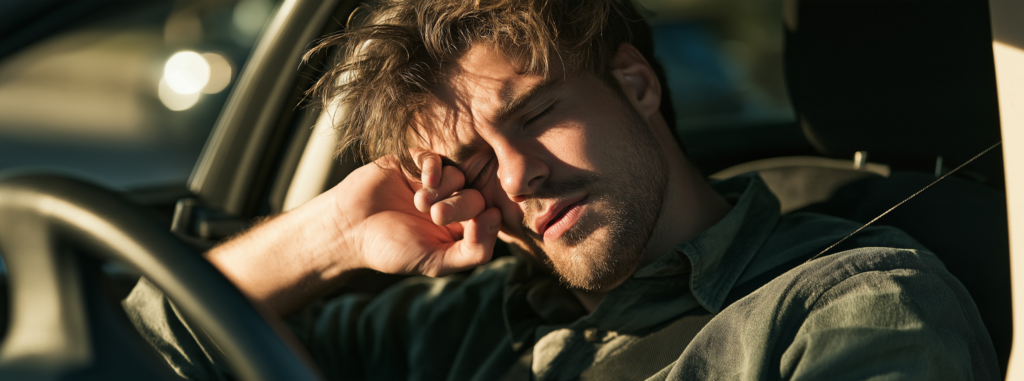

When we speak about being worn out, we tend to use a range of words interchangeably: drowsiness, fatigue, tiredness, sleepiness, and lethargy. In everyday conversation, this is fine. In a safety-critical workplace, it is not. These words describe different states, with different causes, and only one of them reliably predicts whether someone is about to make a serious error.
The short answer
Drowsiness is a neurological state on the continuum between being awake and asleep. Fatigue is a reduction in the efficiency of a muscle or organ after prolonged activity. Tiredness and sleepiness are the subjective feelings of needing rest. Lethargy is a general lack of energy and motivation. The critical distinction is this: rest relieves fatigue, but rest makes drowsiness worse: a drowsy person who sits down will fall asleep.
Drowsiness, fatigue, tiredness, sleepiness and lethargy compared
| Term | What it is | Typical cause | Does rest resolve it? | How it is measured |
|---|---|---|---|---|
| Drowsiness | A neurological state between wakefulness and sleep, in which cognitive performance is impaired | Sleep drive exceeding wake drive: time awake, prior sleep loss, and time of day | No: rest leads to sleep onset | Objectively, via eyelid movements (Johns Drowsiness Scale) |
| Fatigue | A reduction in the efficiency of a muscle or organ after prolonged activity | Sustained physical exertion or prolonged task duration | Yes: rest restores function | Physical performance testing; task duration models |
| Tiredness | The subjective feeling of needing rest or sleep | Any of the above, plus stress, boredom, or illness | Sometimes | Self-report scales such as the Karolinska Sleepiness Scale |
| Sleepiness | In common use, a synonym for tiredness; in sleep medicine, the propensity to fall asleep | Sleep loss, circadian timing, sleep disorders | Only sleep resolves it | Self-report scales; sleep latency testing |
| Lethargy | A general lack of energy, motivation, or alertness | Illness, medication, poor nutrition, depression | Varies with the underlying cause | Clinical assessment of the underlying condition |
What is drowsiness?
Drowsiness is not a feeling. It is a neurological state with a physiological process behind it, and it sits on the continuum between being fully awake and being asleep.
Two competing drives determine whether a person becomes drowsy: the sleep drive and the wake drive. They behave like a seesaw, shifting one way or the other depending on how long a person has been awake, how well they slept previously, and what time of day it is.

What builds the sleep drive
- Time awake. Adenosine accumulates in the brain throughout the day, binding to neurons and slowing their activity. Sleep clears it.
- Prior sleep. Sleep loss accumulates across days. Poor sleep on Monday is still exerting pressure on Thursday.
- Time of day. Melatonin release rises as core body temperature falls, producing a pronounced circadian trough between 2:00 and 4:00 a.m.
What holds it back
The wake drive is driven by arousal: visual stimuli, sound, temperature, and mental engagement. This is why the driving environment matters so much. A driver navigating an unfamiliar city is making constant decisions and is unlikely to become dangerously drowsy. Put the same driver on a long, monotonous stretch of highway at 3:00 a.m. and the risk changes entirely.
The danger is that drowsiness is intermittent and largely invisible to the person experiencing it. By the time someone recognises they are drowsy, their body is already fighting sleep.
What is fatigue?
Fatigue
|
Drowsiness
|
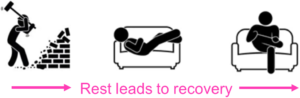

Fatigue is a reduction in the efficiency of a muscle or organ after prolonged activity. It is the state you are in after a long shift of physical labour or an intense session at the gym. It builds progressively with the duration and intensity of the task, and it is relieved by rest.
A fatigued worker may be slower and less productive. They are not, however, at risk of losing consciousness at the controls. That is the distinction that matters.
This creates a persistent problem in industry terminology. When organisations talk about fatigue management, they are almost always describing the prevention of drowsiness: the dangerous state immediately preceding sleep. The label says fatigue; the risk being managed is drowsiness. Using the terms interchangeably in a policy document leads to controls that address exhaustion rather than the state that actually causes performance failure.
What is tiredness, and why is it not the same as impairment?
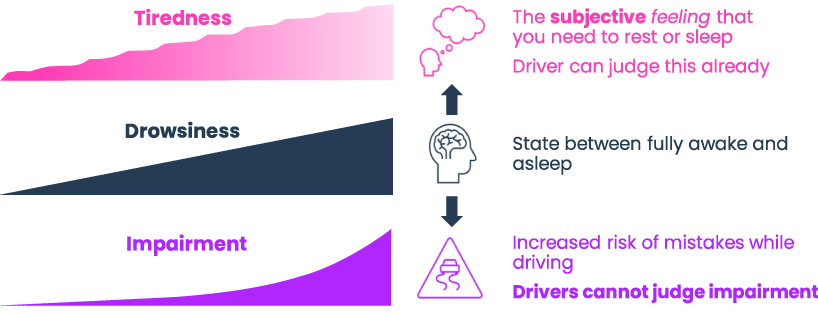
Tiredness is the subjective feeling of needing rest. It is what a person reports when asked how they feel, and it is the basis of self-assessment tools such as the Karolinska Sleepiness Scale (KSS), a 9-point scale ranging from “extremely alert” to “very sleepy, great effort to keep awake, fighting sleep”.
The difficulty with relying on how tired someone feels is straightforward. As a person becomes more impaired, their ability to accurately assess their own state also becomes impaired. Self-report is least reliable exactly when it matters most. A self-reported rating is also unstable over time: one person’s “7” this month may not correspond to their “7” the month before.
What safety-critical operations need to know is not how tired a person feels. It is their impairment: the increase in relative risk of a performance failure. That is an objective, measurable state, and it does not always align with the subjective one.
The two measures can decouple entirely. A person may report a high KSS while remaining unimpaired, or a low KSS while measurably impaired, because the KSS records how tired someone feels and impairment records how much more likely they are to fail. Neither reliably predicts the other.
There is a further problem specific to asking. The act of asking someone how tired they are rouses them, and rousing counteracts drowsiness: two-way conversation is one of the most effective countermeasures there is. Asking the question changes the state being measured.
What about lethargy and sleepiness?
Lethargy describes a general absence of energy, motivation, or alertness. It is typically a symptom rather than a state in its own right, arising from illness, medication, poor nutrition, or depression. A lethargic person is not necessarily close to sleep onset, which is why lethargy is a clinical signal rather than an operational one.
Sleepiness is used two ways. In everyday speech it is a synonym for tiredness. In sleep medicine it refers more specifically to the propensity to fall asleep, which brings it much closer to drowsiness. Where precision matters, drowsiness is the better term, because it names a measurable neurological state rather than a feeling.
Why the distinction matters for safety
Consider the practical consequence of confusing the two most commonly conflated terms.
Fatigue is relieved by rest and inactivity. Drowsiness is made worse by exactly the same conditions. A fatigued worker sent to a quiet room will recover. A drowsy worker sent to the same room will fall asleep, and if they are instead left in a vehicle cab or at a control panel, sleep onset will happen there.
Drowsiness produces intermittent lapses in awareness that the individual does not perceive and will not remember. This is what makes it more dangerous than fatigue from a safety perspective, and why it is the state that a monitoring system needs to detect. Detecting exhaustion after a long shift is useful for roster design. Detecting drowsiness in real-time is what prevents a lane departure.
How drowsiness is measured
Because drowsiness is physiological rather than subjective, it can be measured objectively. Optalert measures it through eyelid movements, which act as a window into the cognitive state of an individual.
The Johns Drowsiness Scale (JDS™) scores impairment from drowsiness on a 0–10 scale, derived from 64 mathematical parameters extracted from the eyelid signal and tracked over time. It was developed by Dr. Murray Johns, initially modelled on the laboratory-based Johns Test of Vigilance (JTV™) and then refined against performance failures recorded in drivers in the field.
The JDS is a validated neurological biomarker, and its predictive power holds across ages, genders, and ethnicities. A 2010 validation study published in Sleep concluded that drowsiness measured this way is commensurate with gold standard laboratory measures.1 In a 2023 study published in the Journal of Sleep Research, in which subjects were kept awake for 32 to 34 hours before a two-hour drive on a closed track, the JDS predicted lane departures with a third of the errors of the KSS and generated a third as many false alerts.2
The distinction drawn throughout this article is what makes that possible. A system built to detect tiredness is measuring a feeling. A system built to detect drowsiness is measuring the increase in relative risk of a performance failure, which is the number an operation can actually act on.
Frequently asked questions
What is the difference between drowsiness and fatigue?
Drowsiness is a neurological state on the continuum between wakefulness and sleep, in which cognitive performance is impaired. Fatigue is a reduction in the efficiency of a muscle or organ after prolonged activity. Rest relieves fatigue, but rest causes a drowsy person to fall asleep.
Is drowsiness the same as being tired?
No. Tiredness is the subjective feeling of needing rest. Drowsiness is an objective neurological state that can be measured physiologically. A person can feel alert while being measurably impaired by drowsiness, which is why self-assessment is unreliable in safety-critical work.
Which is more dangerous, drowsiness or fatigue?
Drowsiness. It produces intermittent lapses in awareness that the individual does not perceive at the time and will not recall afterwards, and it precedes sleep onset. Fatigue reduces efficiency but does not carry the same risk of losing consciousness at the controls.
What is the difference between drowsy and lethargic?
A drowsy person is close to sleep onset and will fall asleep if they stop moving. A lethargic person lacks energy and motivation but is not necessarily approaching sleep. Lethargy usually points to an underlying cause such as illness, medication, or poor nutrition.
How is drowsiness measured?
Objectively, through eyelid movements. The Johns Drowsiness Scale scores impairment from drowsiness on a 0–10 scale using 64 parameters derived from the eyelid signal. Subjective alternatives such as the Karolinska Sleepiness Scale rely on self-report and correlate poorly with impairment in the early stages.
Does “fatigue management” mean managing fatigue?
Usually not. In mining, transport, and rail, the term is generally used to describe the prevention of drowsiness: the state immediately preceding sleep. The distinction matters when designing controls, because the two states respond to opposite interventions.
References
- Anderson C, et al. Real-time drowsiness as determined by infrareflectance oculography is commensurate with gold standard laboratory measures: a validation study. Sleep. 2010;33.
- Cori JM, Wilkinson VE, Soleimanloo SS, Westlake J, Stevens B, Rajaratnam SMW, Howard ME. A brief assessment of eye blink drowsiness immediately prior to or following driving detects drowsiness related driving impairment. J Sleep Res. 2023 Jun;32(3):e13785. doi:10.1111/jsr.13785
Getting the terminology right is the first control
Precision here is not pedantry. An operation that manages fatigue when its actual exposure is drowsiness will build rosters and rest policies that do not address the risk it is carrying. Measuring the right thing begins with naming it correctly.
Contact Optalert to discuss how objective, real-time drowsiness measurement can give your operation the data it needs to manage impairment before it becomes a performance failure.