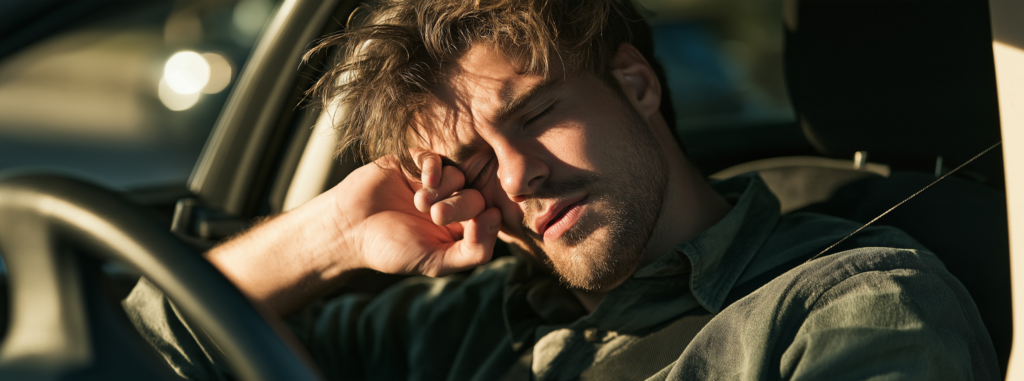

Search for a way to stop yourself falling asleep at the wheel and you will find a large market of inexpensive devices and apps: Earpieces that buzz when your head tilts, wristbands that vibrate, smartphone apps that ask you to tap the screen, and dashboard cameras that sound an alarm when your eyes close.
They are marketed as life-saving technology. The honest answer to whether they work is more useful than either the marketing or the dismissal.
The short answer
Most consumer anti-sleep devices detect that you are already falling asleep and then try to wake you. That is a fundamentally different thing from preventing the situation. By the time a head-tilt sensor or an eye-closure alarm triggers, a microsleep has typically already happened and the vehicle may already have left its lane. These devices are best understood as wake-up alarms, not stay-awake systems, and none of them substitutes for sleep.
How the main types work, and where each one fails
| Device type | What it detects | When it alerts | Main weakness |
|---|---|---|---|
| Head-tilt earpiece | The angle of your head passing a threshold | After your head has already dropped | Head drop follows sleep onset. A drowsy driver can drift out of a lane while sitting upright. |
| Reaction-time app | How quickly you tap or respond to a prompt | When a response is slower than a set threshold | Cannot separate drowsiness from ordinary distraction: a complex intersection or a conversation slows responses too |
| Steering or lane-position monitor | Erratic steering input or lane drift | After control has already degraded | Measures the consequence, not the cause. Alerts once the error is happening. |
| Camera eye-closure alarm | Eyes closed beyond a set duration | During or after a prolonged closure | Long eye closure is a late-stage sign, and normal blinks often continue during a microsleep, so the eyes may remain at least partly open throughout.3 |
| Wristband or vibration alert | Movement, or a timed prompt | On a schedule, or after reduced movement | No relationship to the driver’s actual neurological state |
Why “real-time” does not mean what the marketing implies
 Nearly every product in this category advertises real-time operation. The phrase is doing two different jobs, and the difference is the whole argument.
Real-time response means the device reacts the instant it registers a problem. The alarm sounds immediately, but only once something has already gone wrong.
Real-time monitoring means your state is being measured continuously, so a trend toward danger is visible before the danger arrives.
Consumer devices almost all deliver the first. They are event detectors with a fast trigger. A driver relying on one is depending on being woken after a microsleep rather than on not having one.
Why reaction-time tests are unreliable in a car
 Apps that periodically ask a driver to tap the screen or move a hand are measuring something real: response latency does increase with drowsiness. The problem is that it increases for many other reasons as well.
Navigating an unfamiliar intersection, holding a conversation with a passenger, or adjusting the climate control all delay a response. An app has no way to distinguish those from a drowsiness-related lapse, so it either alarms constantly or sets its threshold so high that it only fires when the driver is already severely impaired.
There is a second problem specific to this design: The prompt itself is a stimulus. Asking a drowsy driver to interact with a screen adds a cognitive task to a driver who has too little attention to begin with.
Why self-assessment does not rescue the design
Some apps ask the driver to rate their own drowsiness before setting off, and calibrate to that.
This inherits a well-established problem. As a person becomes more impaired, the cognitive capacity required to judge their own state degrades in step. Self-report is least accurate exactly when accuracy matters most, and a driver at a genuinely dangerous level will frequently report feeling capable.
A system calibrated to an unreliable self-rating is not more accurate than the rating it started from.
What actually keeps a driver alert?
Only sleep resolves sleep loss. Everything else buys time, and the amount of time is smaller than most drivers assume.
- A nap of about 30 minutes increases alertness for up to a few hours. Longer naps induce deeper sleep and worsen sleep inertia: the grogginess on waking, which can impair performance for up to an hour.1 Do not drive immediately after waking.
- Caffeine, around 200 mg (roughly two to three cups of coffee) improves alertness and takes about 30 minutes to reach full effect.2
- Both together: caffeine taken immediately before a short nap is the most effective combination available, because the caffeine absorbs while you sleep and offsets the sleep inertia.
None of these is a substitute for adequate sleep, and none makes it safe to continue a journey that should be stopped.
Detecting sleep onset versus predicting risk
The distinction that separates a consumer alarm from an operational monitoring system is when in the sequence the measurement happens.
A device that detects sleep onset is measuring an event that has already occurred. A system that measures impairment (the increase in relative risk of a performance failure) is measuring a state that is rising before any event happens, which is the only point at which an intervention can still prevent one.
Optalert measures impairment through eyelid movements, scored on the Johns Drowsiness Scale (JDS™) from 0 to 10 and updated every minute. Risk begins rising above a score of 3.0 and increases substantially above 4.5, which means a supervisor watching the trend can act well before the driver is anywhere near a microsleep.
So what should you actually do?
The right answer depends on which problem you have.
If you are an individual driver
No device on the consumer market will make it safe to drive while drowsy, and buying one may make things worse if it encourages you to keep going. If you are drowsy enough to be shopping for an anti-sleep alarm, the effective response is to stop, sleep, or not make the trip. A nap and a coffee will get you to somewhere you can rest properly. They will not get you home safely across three more hours.
If you are responsible for a fleet or a workforce
 This is a different problem, and it does have a technical answer. Where drivers or operators are working to a roster in a safety-critical role, objective real-time measurement gives supervisors a graded signal they can act on, rather than an alarm that fires once an incident is already in progress. That is what Optalert’s systems are built for, in mining haulage, rail, and long-distance transport.
Frequently asked questions
Do anti-sleep alarms actually work?
They work as alarms, not as prevention. Most detect that sleep onset has already begun (through head tilt, eye closure, or degraded steering) and then attempt to wake the driver. By that point a microsleep may already have occurred and the vehicle may already have drifted.
What is the best anti-sleep device for drivers?
For an individual driver, none of them is a solution. They detect sleep onset rather than preventing it, and none substitutes for sleep. For fleets and safety-critical operations, systems that measure impairment objectively and continuously (rather than triggering on a late-stage event) are a genuinely different category of product.
Can an app tell if I am too tired to drive?
Not reliably. Reaction-time apps cannot separate drowsiness from ordinary distraction, and apps relying on self-rating inherit the problem that people judge their own impairment poorly, especially when impaired.
What actually keeps you awake while driving?
Only sleep resolves sleep loss. A nap of about 30 minutes increases alertness for a few hours, and around 200 mg of caffeine takes roughly 30 minutes to reach full effect. Taking caffeine immediately before a short nap is the most effective combination. All of them buy time rather than removing risk.
Why do camera-based alarms alert too late?
They generally trigger on prolonged eye closure, which is a late-stage indicator. Risk has usually been elevated for at least 30 minutes by then, and microsleeps can occur while the eyes remain open.
Is there a breathalyser equivalent for drowsiness?
Not for roadside enforcement. There is, however, an objective measure used in workplace and automotive settings: the Johns Drowsiness Scale, which scores impairment from eyelid movements on a 0 to 10 scale.
References
- National Institute for Occupational Safety and Health (NIOSH). Training for Nurses on Shift Work and Long Work Hours, Module 7: Napping, an Important Fatigue Countermeasure. Centers for Disease Control and Prevention. cdc.gov
- Centofanti S, et al. A pilot study investigating the impact of a caffeine-nap on alertness during a simulated night shift. Chronobiol Int. 2020. PMID: 32819191.
- Ftouni S, et al. PERCLOS-based technologies for detecting drowsiness: current evidence and future directions. SLEEP Advances. 2023;4(1):zpad006. doi:10.1093/sleepadvances/zpad006
The question worth asking of any device
Before buying anything in this category, ask one question: Does it tell me something before the dangerous moment, or after it?
Almost everything sold to individual drivers answers “after”. That is not useless (being woken is better than not being woken), but it is not what the marketing promises, and it is not a reason to continue a journey.
If you are responsible for people driving as part of their work, contact Optalert to discuss what objective measurement would show about your operation.