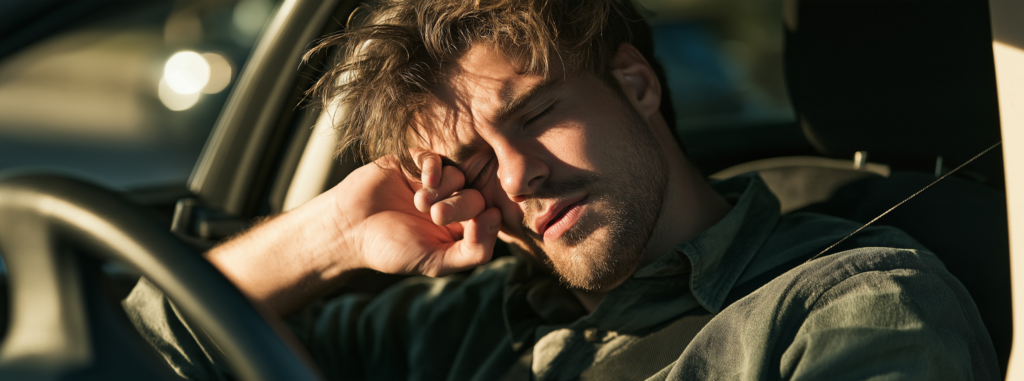

Sleep loss does not announce itself. A worker who slept five hours looks the same as one who slept eight, reports for the same shift, and believes they are functioning normally. The measurable difference in their performance is substantial, and it appears after a single bad night.
The short answer
 Sleep deprivation degrades reaction time, vigilance, memory, and decision-making before it produces any visible sign. After roughly 17 hours awake, cognitive performance is impaired to a degree equivalent to a blood alcohol concentration of 0.05%: the legal driving limit in Australia and much of Europe. The effects accumulate across consecutive nights, and the affected person is consistently the worst judge of their own state.
What sleep loss does to workplace performance
The effects fall into two groups: Those that appear immediately, and those that build with repeated nights of insufficient sleep.
| Effect | Onset | Operational consequence |
|---|---|---|
| Slowed reaction time | After one night | Delayed response to hazards, late braking, missed stop signals |
| Reduced vigilance | After one night | Lapses in attention during monotonous tasks: the highest-risk failure mode in haulage and long-distance driving |
| Impaired working memory | After one night | Difficulty retaining verbal instructions, procedures, and radio communications |
| Increased distractibility | After one night | Greater susceptibility to interruption during safety-critical tasks |
| Degraded decision-making | Within days | Poorer risk judgement and reduced tolerance for others |
| Irritability and low mood | Within days | Team friction, reduced compliance with procedure |
How does sleep loss compare with alcohol impairment?
The most useful comparison for anyone building a safety case is the one to alcohol, because alcohol is a risk every operation already takes seriously.
Research published in Nature in 1997 compared the two directly. After roughly 17 hours of sustained wakefulness, cognitive performance was impaired to a degree equivalent to a blood alcohol concentration (BAC) of 0.05%. At 24 hours awake, the equivalent was 0.10%.1 That is the legal driving limit in Australia, France, and Iceland among others, and the level at which most operations would send a worker home without hesitation.
No operation would allow an employee to operate a haul truck at 0.05% BAC. Many allow the equivalent level of sleep-related impairment to walk onto site unremarked, because there is no breathalyser for it, and because the worker in question will report feeling fine.
There is one further difference, and it runs in the wrong direction. Alcohol impairment resolves predictably as the body metabolises alcohol. Sleep debt does not clear on a schedule, and the only thing that discharges it is sleep.
Why vigilance fails before anything else
Not all cognitive functions degrade at the same rate. The first to go is sustained attention during undemanding tasks: precisely the profile of long-haul driving, night-shift monitoring, and repetitive haulage circuits.
A sleep-deprived person can perform well on a short, engaging, novel task and fail badly on a long, monotonous one. This is why an assessment at the start of a shift tells an operation very little about the risk carried at hour nine, and why a worker who handled the morning without incident may still be the person who drifts out of a lane on the drive home.
The failure itself is brief. A lapse in attention lasting under a second is enough to miss a signal or leave a lane, and the person experiencing it frequently does not register that it happened.
Why shift workers carry the most risk
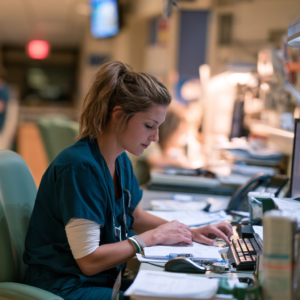 Irregular rosters do not simply reduce the amount of sleep available. They disrupt the circadian timing that determines how restorative that sleep is.
Healthcare offers a clear illustration. Nursing rosters are frequently irregular by design: 12-hour shifts for three consecutive days followed by a different pattern the following week, with changes at short notice. Rotation is common and a fixed schedule is rare. The result is sleep taken at inconsistent times, of inconsistent quality, in a profession where a lapse in judgement transfers directly to a patient.
The same pattern appears in mining, rail, and long-haul transport, and it carries a specific and often unmanaged exposure: the commute. A 2016 study published in PNAS put sixteen night-shift workers through two two-hour daytime drives on a closed track: one after normal sleep, one after a night shift. After normal sleep there were no near-crashes and no drives abandoned. After the night shift, 37.5% of drives produced a near-crash and 43.8% had to be terminated early for safety.2
That risk falls outside the hours most fatigue management policies actually cover. A worker who completes a 12-hour night shift without incident and then drives home is at their most impaired at the exact moment supervision ends.
Why workers cannot self-assess
Every control described above depends on knowing who is impaired. The intuitive method (asking people how tired they feel) is the one method that reliably fails.
As impairment increases, the cognitive capacity required to evaluate one’s own state is itself degraded. Self-report is least accurate precisely when accuracy matters most. A worker at a genuinely dangerous level of drowsiness will often report feeling capable, and will not be lying.
This is also why tiredness and impairment must be treated as separate things. Tiredness is a feeling. Impairment is the increase in relative risk of a performance failure, and it can be measured objectively.
The two can decouple completely. A worker may feel exhausted and test as unimpaired, or feel capable and test as dangerously impaired. Asking also changes the answer: rousing someone to ask how they feel briefly counteracts the drowsiness being measured.
What an operation can measure instead
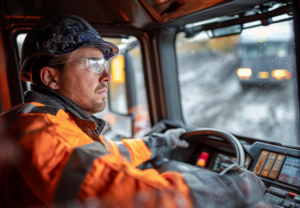 Because drowsiness is a physiological state rather than a subjective one, it can be measured directly. Optalert measures it through eyelid movements, scored on the Johns Drowsiness Scale (JDS™) from 0 to 10 and updated every minute.
That produces something a roster model cannot: a real-time, per-worker measure of current impairment, rather than a prediction of who ought to be impaired based on hours worked. Rosters and rest policies remain necessary. They are, however, estimates, and an estimate cannot tell a supervisor which specific driver is approaching a dangerous level right now.
Frequently asked questions
How does sleep deprivation affect work performance?
It slows reaction time, reduces sustained attention, impairs working memory, increases distractibility, and degrades decision-making. Reaction time and vigilance are affected first, and both can be measurably impaired after a single night of restricted sleep.
Is sleep deprivation comparable to being drunk at work?
In terms of cognitive performance, roughly 17 hours awake produces impairment equivalent to a blood alcohol concentration of 0.05%: the legal driving limit in Australia and much of Europe. Unlike alcohol, there is no simple roadside test for it, and the affected person usually reports feeling fine.
How long does it take for sleep deprivation to affect performance?
Impairment equivalent to the 0.05% BAC driving limit appears after roughly 17 hours awake. Reaction time, vigilance, memory, and distractibility are affected after a single night of restricted sleep. Decision-making, mood, and irritability degrade further across consecutive nights of insufficient sleep.
Why are shift workers most at risk?
Irregular rosters disrupt both the quantity and the circadian timing of sleep. In a 2016 PNAS study, 37.5% of test drives taken after a night shift produced a near-crash, against none after normal sleep. The highest-risk period (the commute home) falls outside the hours most fatigue management policies cover.
Can workers tell when they are too impaired to work safely?
Generally no. The ability to assess one’s own state degrades along with everything else, so self-report becomes least reliable exactly when it matters most. Objective measurement is the only dependable method.
What is the difference between feeling tired and being impaired?
Tiredness is a subjective feeling. Impairment is the increase in relative risk of a performance failure: an objective state that can be measured physiologically, and one that does not always align with how a person feels.
References
- Dawson D, Reid K. Fatigue, alcohol and performance impairment. Nature. 1997;388:235. doi:10.1038/40775
- Lee ML, Howard ME, Horrey WJ, Liang Y, Anderson C, Shreeve MS, O’Brien CS, Czeisler CA. High risk of near-crash driving events following night-shift work. Proc Natl Acad Sci USA. 2016;113(1):176-181. doi:10.1073/pnas.1510383112
Measuring what a roster can only estimate
Sleep loss is one of the few workplace hazards that is simultaneously well understood, widely acknowledged, and largely unmeasured. Operations manage it through rosters and rest policies, which are reasonable controls built on population averages, and then rely on individual workers to report a state they are demonstrably unable to assess.
Contact Optalert to discuss how objective, real-time drowsiness measurement can show you where the risk actually sits in your operation.