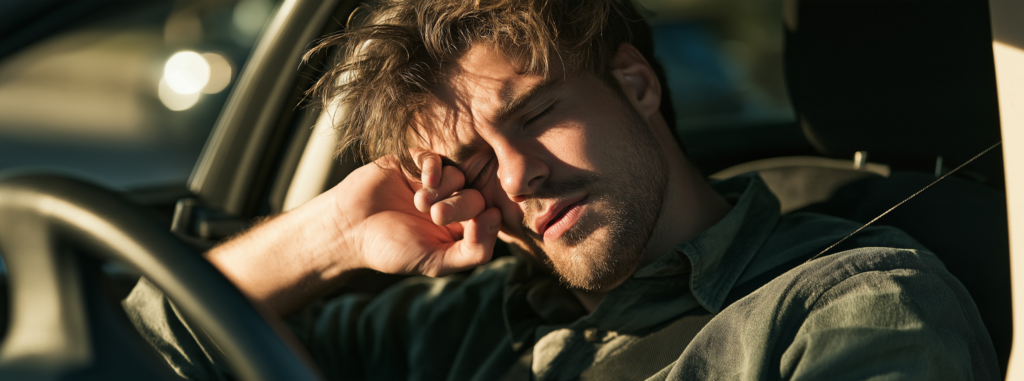

 You’re on a familiar highway. The road is straight, the engine hums, and your eyes are open. Then, without warning, several seconds vanish. You have no memory of them. The car drifted slightly. You didn’t notice. You were asleep.
This is a microsleep. And it is one of the most dangerous, least understood phenomena in fatigue science.
At Optalert, we have dedicated years to researching, detecting, and ultimately preventing the kind of drowsiness that leads to these events. Understanding why microsleeps happen – and crucially, when they are about to happen – is the foundation of everything we do.
What is a microsleep?
A microsleep is a brief, involuntary episode of sleep that lasts anywhere from a fraction of a second to about 15 seconds. The brain, overwhelmed by sleep pressure, essentially forces a shutdown – a momentary blackout – regardless of what the person is doing or how urgently they need to stay awake.
Unlike the gradual drift into full sleep, microsleeps are largely undetectable by the person experiencing them. In most cases, the individual has no awareness that they occurred at all. Ask someone who has just had a microsleep whether they fell asleep, and they will almost universally say no. This is not denial. It is a physiological reality. The sleeping brain does not encode the experience of sleeping.
That unawareness is precisely what makes microsleeps so lethal.
The science behind why microsleeps occur
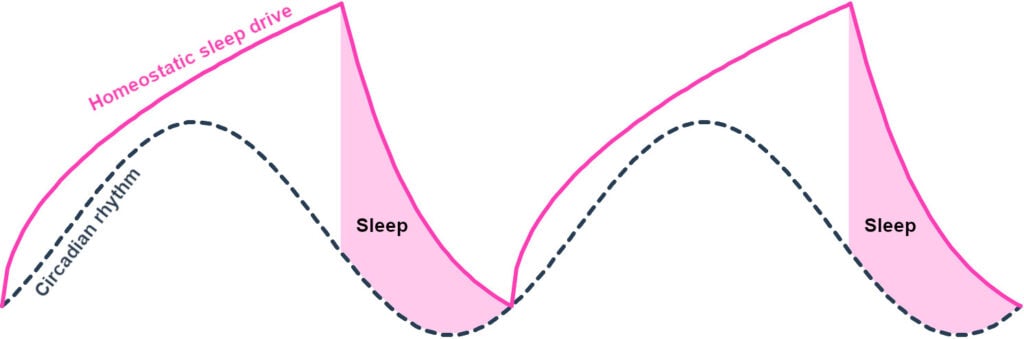 Sleep is regulated by two primary biological systems:
- circadian rhythm, which governs the timing of sleep and wakefulness over a 24-hour cycle, and
- sleep homeostasis, the accumulating pressure to sleep the longer you remain awake.
When these two forces align – particularly in the early hours of the morning, or after extended periods without rest – the drive to sleep becomes overpowering.
During prolonged wakefulness, neurons in the brain begin to enter brief rest states even while the person remains technically conscious. This process, known as local sleep, means that parts of the brain are effectively offline while others are not. A microsleep is what happens when this fragmented shutdown becomes more widespread, overwhelming the conscious mind’s ability to override it.
Key contributing factors include the following:
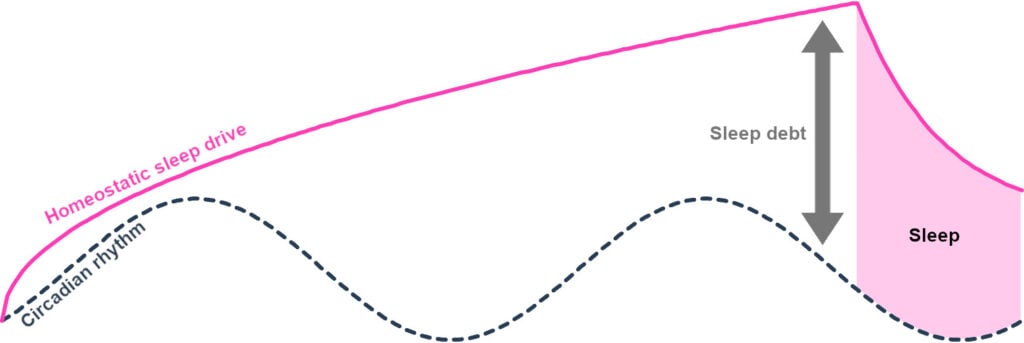
- Sleep debt: Even a single night of reduced sleep meaningfully impairs alertness and increases the risk of microsleep. Multiple nights of poor sleep compound sleep debt.
- Time of day: Risk peaks between 2:00 and 6:00 a.m. and again in the early-to-mid afternoon, corresponding to natural circadian dips.
- Shift work and irregular schedules: Workers whose hours conflict with natural sleep cycles face substantially elevated risk.
- Monotonous environment: Long stretches of highway, repetitive tasks, or low-stimulation settings reduce the sensory input needed to sustain wakefulness.
- Undiagnosed sleep disorders: Conditions such as obstructive sleep apnoea fragment sleep architecture and create chronic sleep debt, even when a person believes they are sleeping enough. Sleep disorders are particularly dangerous because even at their most “well rested”, the individual is impaired.
The death stare: Microsleeps with eyes open
 Here is where public understanding of microsleeps often breaks down entirely.
Many people assume that falling asleep means eyes closed. However, many microsleeps occur with the eyes either fully or partially open. This phenomenon is colloquially known as the “death stare”, and clinically referred to as open-eye microsleep.
During a death stare, the individual appears awake. Their eyes are forward-facing, their posture upright, their hands perhaps still on a wheel or a control panel. But the brain is not processing incoming information. Visual signals arrive at the eyes, but the driver does not respond. In Optalert research conducted in a driving simulator, sleep-deprived test participants, with their eyes wide open, appeared completely calm while repeatedly driving into a barrier.
Research has found that a significant proportion of all microsleep events occur with eyes open. Any safety system that relies solely on long eyelid closures or head nodding to detect drowsiness will respond too late. By the time a driver’s eyes close or their head falls forward, they may have already experienced multiple microsleeps. These visible signs of impairment are lagging indicators. The real risk came earlier, and it was only detectable via very subtle changes in eyelid movements.
This is a fundamental challenge for the field of fatigue detection and the reason why so many systems leave drivers (and fleets) exposed to risk. You cannot watch someone’s face and reliably know whether they are experiencing a microsleep without extremely sophisticated algorithms processing eyelid movements.
How does a microsleep differ from a lapse in attention?
In many instances, a person can exhibit a lapse in attention which involves non-response to a physical stimulus. In practice, this involves a driver not applying corrective steering wheel movements as they drift out of lane, or not braking when an obstacle appears. A lapse can occur with eyes open or during a long eyelid closure, but does not involve a microsleep (i.e., theta-dominant EEG activity).
The impairment window: Why early detection is everything
 The critical insight in fatigue science, and the insight that drives Optalert’s technology, is that microsleeps are not the beginning of the problem. They are the culmination of it.
Long before a microsleep occurs, the brain exhibits measurable signs of declining alertness. Reaction rate drops. Sustained attention fades. Neural activity shifts toward patterns consistent with sleep onset. All of this happens before the person loses consciousness, and all of it increases the probability of a microsleep every minute.
This is why the goal of responsible fatigue management cannot simply be detecting microsleeps. By definition, a system that detects a microsleep only tells you the worst has already happened. The goal must be detecting the physiological indicators of impairment before a microsleep occurs – while there is still time to act.
Early intervention matters because:
- Impaired reaction time compounds risk: A driver experiencing fatigue-related cognitive slowing is less able to respond to hazards even without a microsleep.
- Microsleep onset is unpredictable: There is no reliable warning sensation that precedes a microsleep. People cannot self-assess their own microsleep risk with any accuracy.
- By the time visible signs appear, multiple events may have already occurred: Open-eye microsleeps mean the observable warning signs are not reliable early indicators.
- Environmental conditions can accelerate the timeline: A monotonous road section or a sudden reduction in cognitive load can trigger sleep onset within seconds in an already-fatigued individual.
How Optalert approaches the problem
Optalert’s approach centres on measuring the eyes – not simply whether they are open or closed, but how they move.
The oculomotor system – the network of muscles and neural circuits that control eye movement – is exquisitely sensitive to neurological state. As the brain becomes fatigued, distinct changes emerge in the way the eyelids blink. These changes are detectable and, most importantly, they begin to appear well before a microsleep occurs.
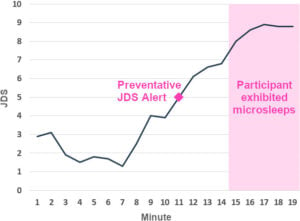
Using advanced sensing and proprietary algorithms, Optalert’s technology continuously monitors these ocular biomarkers and calculates a real-time Johns Drowsiness Scale (JDS) score for a driver. This score rises as impairment develops, providing an objective, continuous measure of alertness that does not depend on the person remaining aware enough to self-report their own state.
Because the measurement captures the underlying neurological process – not just its visible surface manifestations – it can detect impairment minutes before microsleep events. The eyes may be open and actively blinking, but they reveal a person’s level of impairment.
Alerts are triggered when the JDS score crosses clinically validated thresholds, giving operators, drivers, and safety managers the lead time they need to intervene before a microsleep causes harm. A smoke detector instead of a fire alarm.
The stakes are high
Fatigue is implicated in an estimated 20-30% of serious road crashes in industrialised countries. Furthermore, such crashes result in far more severe consequences because drowsy drivers rarely brake or take evasive manoeuvres. In mining, heavy transport, rail, and aviation, where a single lapse can trigger catastrophic outcomes, the numbers are similarly sobering. Unlike alcohol or distraction – both of which have attracted decades of regulatory attention and behavioural intervention – fatigue remains chronically underestimated, partly because the people most at risk are often the least aware of it.
The death stare captures this paradox perfectly. The driver’s eyes are open and they look fine. But they will not react when a critical situation arises. The lights are on but nobody’s home.
Addressing this challenge requires more than education campaigns or rest break policies. It requires objective, real-time measurement of the neurological state driving the risk.
That is why Optalert was founded.
Key takeaway: Microsleeps are not a fringe event
They are a predictable consequence of a fatigued brain that has been pushed beyond its limits – and they happen far more often, and far less visibly, than most people realise. The death stare reminds us that the absence of visible signs is not the same as the absence of risk.
The science is unambiguous: the window for effective intervention lies before the microsleep, in the developing impairment that precedes it. Detecting that impairment early, objectively, and continuously – regardless of whether the eyes are open or closed – is not just the most effective strategy.
It is the only strategy.
Optalert develops scientifically validated technology for the real-time detection of drowsiness and fatigue impairment. The Johns Drowsiness Scale (JDS), developed by Optalert over decades of sleep research, provides an objective, continuous measure of alertness designed to prevent fatigue-related accidents.
Reduce microsleep risk with Optalert’s Drowsiness Monitoring Solutions
Optalert works with mining, transport, and automotive organisations to help them detect and manage drowsiness risk before it leads to harm.
Through our driver drowsiness monitoring technology and the Eagle system, organisations gain objective, real-time insight into driver alertness, enabling proactive intervention well before a microsleep event occurs.
To learn more about how Optalert can support your fatigue risk management, explore our solutions or speak with our team.