
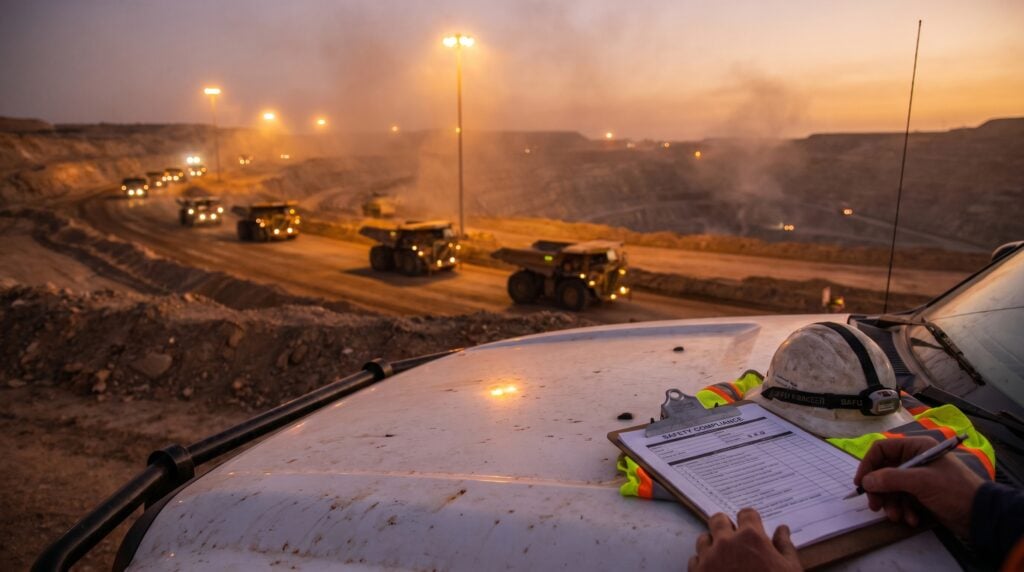
Fatigue kills. In mining, it contributes to equipment rollovers, haul truck collisions, and near-misses that never make the incident report. On the road, it causes roughly one-third of all accidents. Yet the regulatory landscape around fatigue is surprisingly thin, and where rules do exist, enforcement is shifting.
This page covers the regulations that apply to fatigue in both mining and road transport, what they require, and where the gaps leave operators exposed.
Mining Fatigue Regulations in the United States
The Federal Mine Safety and Health Act
The Federal Mine Safety and Health Act of 1977, amended by the MINER Act of 2006, is the backbone of US mining safety law. It gives the Secretary of Labor authority to develop and enforce health and safety standards across all mines in the country.
The Mine Safety and Health Administration (MSHA) enforces these rules under 30 CFR Parts 1 through 199. These regulations cover everything from ventilation and ground control to equipment standards and training requirements.
MSHA and Fatigue: What the Rules Actually Say
Here is where it gets complicated. MSHA does not have a specific fatigue regulation. There is no federal standard that says “miners cannot work more than X hours” or “operators must use fatigue monitoring technology.”
What MSHA does provide is guidance. The agency recommends that miners should not work more than eight consecutive days without a rest day. For underground operations, shifts are generally limited to eight hours, though exceptions exist depending on the work and mine conditions. Surface mining operations have more flexibility in scheduling but must still manage fatigue risk.
MSHA’s standard 56.18002 (and its underground counterpart, 57.18002) requires that miners are not assigned to tasks that are beyond their ability to perform safely. While this doesn’t name fatigue specifically, it creates a legal obligation to ensure workers are fit for duty, and a fatigued worker is not fit for duty.
The General Duty Clause
Section 101(a) of the Mine Act gives MSHA broad authority to cite operators for conditions that create safety hazards, even where no specific standard exists. If fatigue is contributing to incidents at a mine site and the operator has no fatigue management program in place, this provision creates real legal exposure.
What “Mine” Means Is Getting Broader
In April 2026, the D.C. Circuit Court upheld MSHA’s broad definition of a “mine” in a ruling involving K.C. Transport Inc. The court confirmed that any facility “necessarily connected” to extraction or processing falls under MSHA jurisdiction. A trucking company argued it was not a mine. It lost.
This matters because more facilities now fall under MSHA safety jurisdiction. If your operation handles, transports, or processes material connected to mining, MSHA’s rules likely apply to you, including its expectations around fatigue management.
Silica Rule and the Pattern of Regulatory Uncertainty
In April 2026, MSHA indefinitely stayed the compliance deadlines for its 2024 respirable crystalline silica rule. This follows a broader pattern of regulatory delays and funding pressure on the agency.
For mine operators, this creates an uncomfortable situation: the rules are still on the books, enforcement timelines are unclear, and the liability hasn’t gone anywhere.
When Federal Oversight Shrinks, Operator Liability Grows
Reduced MSHA funding and enforcement activity does not reduce an operator’s legal obligations. If anything, it increases exposure.
Here is why. When MSHA conducts regular inspections, operators can point to compliance with federal standards as part of their safety record. When those inspections become less frequent, operators lose that external validation. In the event of an incident, the question shifts from “were you in compliance?” to “what did you do to keep your workers safe?”
Courts and regulators look at what a “reasonable operator” would do. If fatigue monitoring technology exists, if peer companies are using it, and if research shows it prevents incidents, choosing not to use it becomes harder to defend.
The liability equation is straightforward: mine operators carry the duty of care. Federal oversight is a floor. And when the floor is raised, operators who were only meeting the minimum are now visibly underperforming and may be deemed non-compliant.
What This Means in Practice
- Fatigue management plans should be documented, not informal.
- Technology that detects fatigue provides objective, timestamped evidence that you acted on risk.
- Training records showing workers understand fatigue hazards are essential.
- Incident investigations should include fatigue as a factor in root cause analysis.
A mining operation in South America demonstrated the value of proactive fatigue management by deploying Optalert’s Eagle Suite across 200+ haul trucks. The result: a 98% reduction in fatigue risk exposure, a 76% drop in total reported incidents, and a 5% increase in production (tons per hour).
Drowsy Driving Laws and Regulations
United States
Drowsy driving regulation in the US is fragmented. Most states have no specific drowsy driving law. The notable exceptions:
Maggie’s Law (New Jersey, 2003) makes it illegal to knowingly drive while impaired by lack of sleep. A driver who kills someone while fatigued can be charged with vehicular homicide. The law was created after Maggie McDonnell was killed by a driver who had been awake for 30 hours.
SB 874 (Arkansas, 2013) classifies causing a fatality as a fatigued driver under “negligent homicide.” A fatigued driver is defined as someone who has been awake for 24 consecutive hours.
Federal trucking rules require professional truck drivers to take mandatory breaks, including a 34-hour restart after a full work week. The gap: there is no way to verify that a driver used that time to actually sleep. You can follow the letter of the law and still be dangerously fatigued.
United Kingdom
Under UK law, “driving while knowingly deprived of adequate sleep or rest” falls under the offence of Death by Dangerous Driving. It is classified as Level 3 seriousness (significant risk of danger). UK research indicates that around 20% of accidents on major roads are sleep-related, which suggests the Level 3 classification may understate the actual risk.
Australia
Australia’s Heavy Vehicle National Law standardized trucking regulations across most states and territories. The framework operates in three tiers:
- Standard Hours set the baseline work and rest hours for heavy vehicle drivers.
- Basic Fatigue Management allows flexible scheduling if fatigue risk is properly managed.
- Advanced Fatigue Management allows greater flexibility in exchange for operators demonstrating higher accountability for managing fatigue risks.
These regulations include electronic work diary requirements and defined penalty structures for non-compliance.
Why Self-Assessment Doesn’t Work
A consistent finding across fatigue research is that people cannot reliably assess their own drowsiness. This is a fundamental problem for regulations that rely on a worker “knowingly” operating while fatigued.
Research published in Mining Engineering (Bauerle, Dugdale, and Poplin, 2018) found that mining environments are particularly susceptible to fatigue due to the simultaneous presence of dim lighting, hot temperatures, loud noise, repetitive tasks, long shifts, and remote commute distances. The authors noted that this unique combination of factors may require mining-specific fatigue management approaches rather than borrowing from other industries.
This is precisely why objective measurement matters. Subjective self-assessment creates a gap in both safety and legal defensibility. A system that measures drowsiness objectively provides the evidence that regulations alone cannot.
The Role of Technology in Meeting Safety Obligations
Regulations set the floor. Technology determines whether you actually prevent incidents or just comply on paper.
Camera-based driver monitoring systems detect long eyelid closure events, but by the time those events occur, the operator has already been dangerously fatigued for up to an hour. In remote mining environments, alerts from these systems can be delayed further, sometimes reaching the control room hours after the event.
Optalert’s Eagle Suite uses the Johns Drowsiness Scale (JDS), a physiological biomarker that Harvard Medical School has deemed “commensurate with gold standard laboratory measures.” It detects fatigue 15 to 30 minutes before camera-based or EEG systems, providing early warnings that allow intervention before risk becomes critical.
For operators looking to go beyond compliance and build a genuine safety record, the difference between reactive and predictive fatigue detection is the difference between documenting incidents and preventing them.
Frequently Asked Questions
Does MSHA require fatigue monitoring in mines?
MSHA does not mandate specific fatigue monitoring technology. However, operators have a general duty to ensure workers are fit for duty and to manage known hazards. Fatigue is a recognized hazard in mining, and operators without a fatigue management program face legal exposure under the Mine Act’s general duty provisions.
How many consecutive days can a miner work?
MSHA recommends no more than eight consecutive working days before a rest day. Many mining companies and union contracts set tighter limits of six to seven days. There is no hard federal cap, but exceeding recommended limits increases both safety risk and potential liability.
What is MSHA Standard 56.18002?
This standard requires that miners are not assigned tasks beyond their ability to perform safely. While it does not name fatigue specifically, it creates an obligation to ensure workers are not impaired by fatigue when performing safety-critical work.
Are drowsy driving laws the same in every US state?
No. Most US states have no specific drowsy driving law. New Jersey and Arkansas have explicit statutes. Federal trucking regulations set hours-of-service rules for commercial drivers, but enforcement is limited to schedule compliance, not actual fatigue levels.
How does reduced MSHA enforcement affect mine operators?
Reduced enforcement does not reduce legal obligations. Operators still carry the duty of care for worker safety. In fact, less federal oversight can increase liability because operators can no longer rely on regular inspections as evidence of compliance. Proactive safety measures, including documented fatigue management programs and objective monitoring technology, become more important when external oversight decreases.