
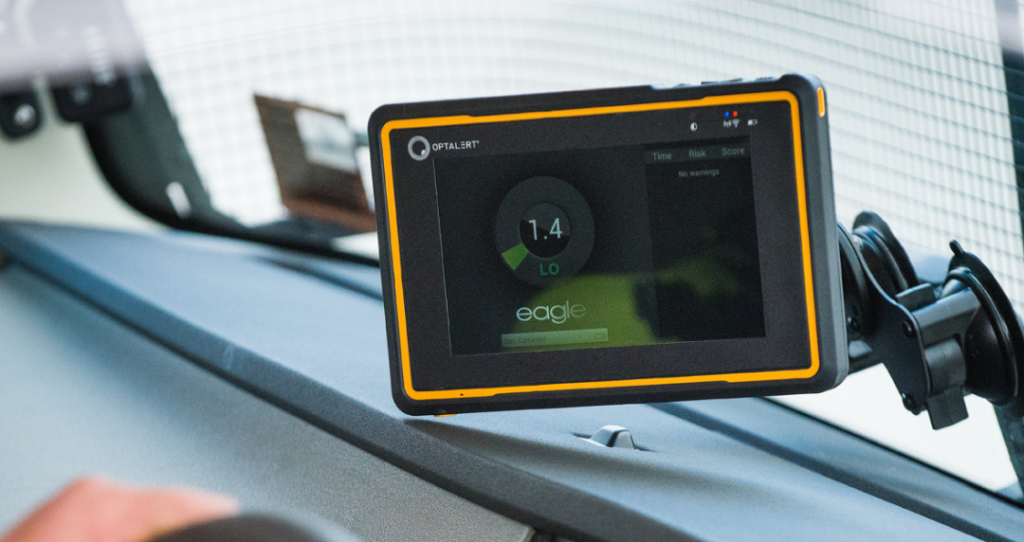
The challenge: frequent incidents in a high-risk environment
A large mining operation in South America was facing persistent safety challenges associated with fatigue in haulage operations.
Operating 24 hours a day with a continuous shift structure, the site was recording close to 60 haul truck-related incidents per year. Many of these incidents involved heavy mobile equipment and carried a high potential for serious injury or fatality.
Over time, fatigue was identified as a key contributor to degraded performance during critical operating periods.
The challenge was not simply recognising fatigue as a risk, but finding a way to detect it early enough to prevent the risk becoming elevated.
Our solution: predicting fatigue before it becomes critical
To address this risk, the operations team implemented Optalert’s predictive fatigue detection system across its entire off-road haulage fleet of more than 200 trucks.
Rather than treating fatigue as a reactive safety issue, the site adopted Optalert as part of a long-term fatigue management strategy. The program combined real-time fatigue monitoring with clear operational procedures and control-room oversight, allowing supervisors to identify elevated fatigue risk and intervene early.
With Optalert’s Eagle Suite, fatigue was no longer assessed subjectively or after the fact. It became a measurable, visible, and operationally manageable hazard.
The results: near-elimination of fatigue risk
Following implementation, the operation recorded clear and sustained improvements across safety and productivity metrics:
- 98%
- 76%
- 5%
reduction in
reduction in
increase in
fatigue risk exposure
total reported incidents
production (tons per hour)
These outcomes demonstrated a direct link between proactive fatigue management, improved safety performance, and operational efficiency across the haul truck fleet.
Why previous systems fell short and how Optalert outperformed them
Before selecting Optalert, the operation evaluated camera-based fatigue monitoring systems.
However, such systems only sound alerts during long eyelid closure (LEC) events, when the fatigue risk has already been critical for up to an hour. At this point, the operator is lucky to have not already had an incident.
To compound the issue, due to the remoteness of the site and communication constraints, these fatigue alerts were often delayed further. In some cases, alerts reached the control room hours or even days after the fatigue event had occurred.
This delay severely limited the ability to intervene in real-time. It also reduced operator confidence in the technology and left supervisors without reliable early-warning indicators.
Optalert was chosen as a solution because it detects fatigue at an early stage and transmits actionable data in real-time, enabling intervention while there is still time to prevent an incident.

Key benefit: long-term fleet improvement through measured results and data insights
Fatigue risk was assessed using the frequency of fatigue alerts generated per hour of operation. Multi-year analysis showed a reduction of 98% in alert frequency as the fatigue management program matured.
Fatigue levels were objectively measured using the Johns Drowsiness Scale (JDS™), a validated scale ranging from 0 (fully alert) to 10 (extremely drowsy). Over time, an increasing proportion of fatigue scores remained below 4.5 JDS, indicating low-risk alertness levels.
Meanwhile, average fatigue scores decreased year-on-year, indicating not only effective controls, but lasting behavioural and operational change across the workforce.
Before and after: from reactive response to proactive risk control
With predictive fatigue data available in real-time, supervisors and control room teams were able to incorporate fatigue risk into daily operational decisions.
This enabled earlier, more targeted interventions during critical operating periods and reduced exposure to high-risk fatigue states before performance was compromised.
The consistent use of objective and actionable fatigue data supported a shift away from reactive incident responses towards more proactive risk preventions. As a result, this strengthened safety culture, improved workforce wellbeing, and increased confidence in fatigue management processes across the site.
Key takeaway: fatigue became predictable, measurable, and controllable
By implementing Optalert’s predictive fatigue monitoring system, the operation transformed fatigue management from a reactive safety concern into a controlled operational risk.
Often described as the difference between a reactive fire alarm and a preventative smoke detector, Optalert’s preventative technology enabled the site to intervene before fatigue led to errors, incidents, or lost productivity.
The result was a safer, more stable operation with measurable gains in both safety performance and production efficiency.
Want to see how predictive fatigue monitoring could reduce risk at your site?
Get in touch using the form below. Just enter your name, email address, and your message, and we’ll get back to you as soon as possible.