

The challenge: longer shifts without increasing risk
A large mining operation in South America faced a major operational decision.
To improve efficiency and workforce planning, the site was considering a transition from a roster of three 8-hour shifts per day to two 12-hour shifts per day.
While the potential operational benefits were clear, leadership had one critical concern: would longer shifts increase fatigue risk and compromise safety?
With a large mobile equipment fleet and more than 2,000 operators working across day and night operations, fatigue-related incidents posed a high-consequence risk. The roster change could not proceed without clear, objective evidence that fatigue exposure would remain within acceptable limits.
Our solution: using objective fatigue data to inform a high-stakes decision
The mine had already been using Optalert’s fatigue detection system for more than five years, providing continuous, objective visibility into operator alertness across multiple fleets and operating conditions.
To support evidence-based decision-making, Optalert was engaged to analyse the potential fatigue impact of the proposed roster change.
A controlled pilot was conducted with a group of haul truck operators transitioning from 8-hour to 12-hour shifts, for a period of three weeks.
Throughout the trial, Optalert continuously measured physiological data of fatigue in real-time, including objective measurements of ocular-based drowsiness indicators. Doing so enabled any fatigue exposure data to be quantified and compared directly against historical data from the existing roster.
Specifically, the analysis focused on key fatigue risk indicators, including the frequency, duration, and severity of elevated drowsiness events, temporal distribution of fatigue across the shift, and comparative risk profiles between day and night operations. These metrics were benchmarked against historical data collected under the 8-hour shift structure, allowing for a direct comparison of fatigue performance between the two roster configurations.
This holistic approach ensured the decision was based on measured fatigue-related risk, not assumptions or self-reported fatigue.
The results: Fatigue risk decreased
The analysis delivered a clear outcome.
When the 12-hour shift model was implemented with appropriate fatigue controls in place, the operation recorded a 13% reduction in overall drowsiness-related accidents compared to the previous 8-hour roster.
Most notably, the data showed that longer shifts did not lead to a proportional increase in dangerous fatigue states. In fact, fatigue risk became more predictable and easier to manage across the operating day.
This result gave leadership the confidence to proceed with the roster transition.
Why the shift change worked, especially on circadian patterns
The reduction in fatigue risk was driven by how the roster was designed, not simply by the length of the shift.
The key factor was the move to a static shift rotation, where operators no longer alternated between day and night shifts. Instead, operators worked consistent 12-hour day or night shifts, followed by regular rest days. In doing so, this helped normalise a worker’s circadian cycle – also known as the biological clock, which regulates automatic bodily functions according to day and night.
When combined with appropriate fatigue management controls, such as static shift allocation, real-time monitoring, and procedural intervention protocols, the 12-hour shift model did not result in a proportional increase in fatigue-related risk.
The risk reduction is, among other factors, directly attributable to the stable rotation schedule. Operators no longer alternated between day, evening, and night shifts, instead working in static 12-hour shifts with three consecutive workdays followed by three days off.
As a result, the static shift rotational structure delivered several benefits:
• Improved alignment with natural sleep and recovery patterns
• Reduced circadian disruption caused by frequent day–night switching
• More predictable routines outside of work, supporting better rest quality
In short, operators could organise their lives around consistent work hours, which reduced cumulative fatigue over consecutive shifts.
Managing night-shift risk with real-time visibility
As expected in mining operations, fatigue risk remained higher during night hours compared to daytime operations. However, Optalert’s real-time monitoring allowed these risks to be identified and managed proactively.
Across the entire fleet:
• Fatigue alerts occurred at a low, measurable rate.
• Approximately 12% of alerts were classified as high risk, triggering immediate intervention protocols such as operator rotation.
• High-risk fatigue events were addressed before performance was compromised.
This ensured that fatigue risk remained controlled even during the most challenging operating periods.
From roster change to operational confidence
Following the analysis and Optalert’s recommendations, the mining operation implemented the 12-hour roster across the site.
The transition was supported by:
• Continuous real-time fatigue monitoring
• Centralised oversight of fatigue risk
• Supervisor-led intervention protocols
This approach ensured that fatigue was managed as an operational risk, not a compliance exercise.
Importantly, the roster change improved not only safety outcomes, but also workforce stability and quality of life, as operators and their families gained greater certainty around work and rest schedules.
Additionally, consolidated data demonstrated that the implementation of the Optalert Fatigue Detection System resulted in a 97% reduction in fatigue-related accident risk at the same site.
The results observed at this operation are significant, as they contribute to an optimised operation that reduces costs while prioritising the safety of the company personnel.
How Optalert managed fatigue monitoring and risk profiling
The Optalert system provides basic functionality to identify operators by name, employee ID, team, and operation. Based on this data, it is possible to detect risk trends by geographical location within the mine by hour of the day, and by shift.
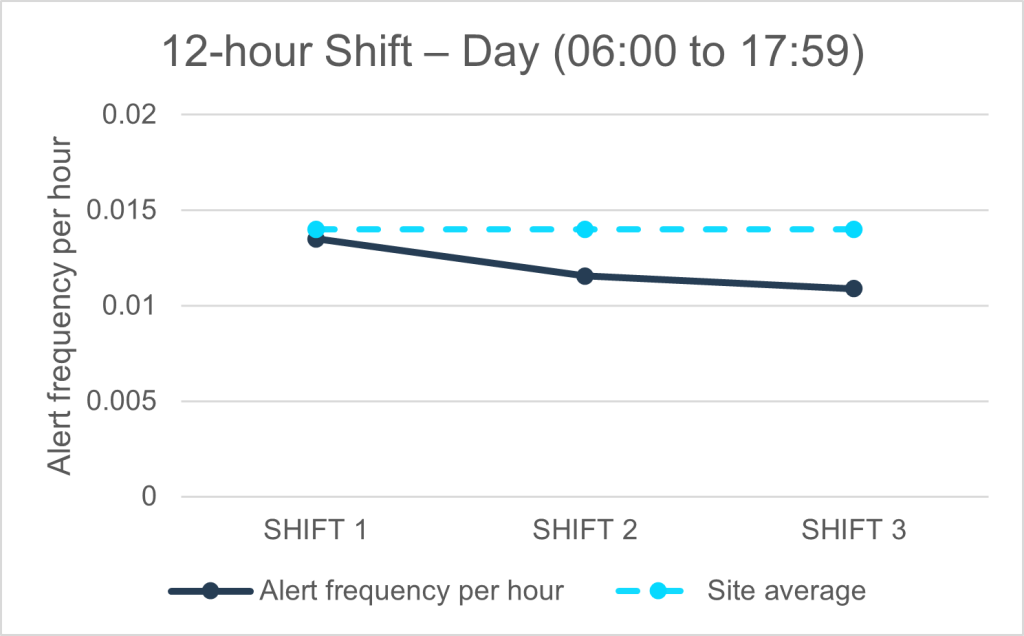
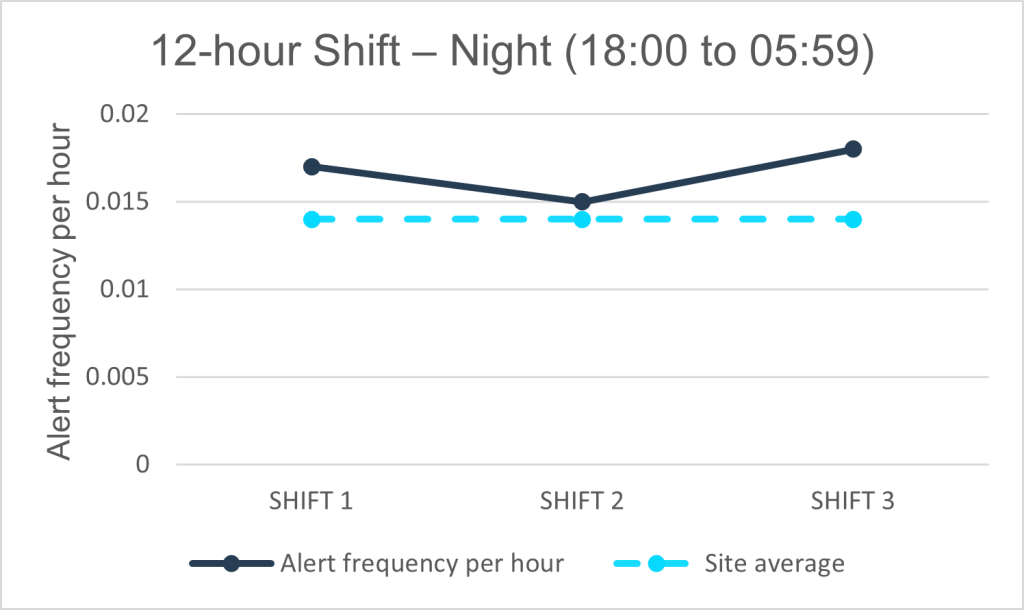
The graph below displays the drowsiness-related accident risk profile, represented by the frequency of drowsiness alerts (risk situations) per hour of operation. The graphs are divided into day and night shifts and, subsequently, by each work cycle.
Notably, operators on the daytime shift return from their days off in “Shift 1” with the highest recorded risk, which gradually decreases in “Shift 2” and Shift 3”. This behaviour is directly linked to non-work activities during days off and possibly reduced quality of rest.
During the night shift, operators also present elevated risk in “Shift 1” for the same reasons observed in the day team. “Shift 2” shows a risk reduction as operators adjust to the night work routine and rest during the day. However, risk increases again in the third shift. This pattern is common in night operations and is directly related to activities that conflict with the natural circadian cycle.
Key benefits: how Optalert enabled and improved operational efficiency
The transition from a schedule of three 8-hour shifts to two 12-hour shifts, combined with the implementation of the Optalert Fatigue Detection System, helped the mine save millions of dollars per year in transport, food, maintenance and overall risks. It also produced measurable operational improvements and safety outcomes:
Reduction in Fatigue-Related Risk
- Overall risk of drowsiness-related accidents decreased by 13% following the shift change.
- High-risk fatigue events, which trigger immediate operator rotation, accounted for 12% of total alerts, ensuring proactive mitigation of critical risk scenarios.
Improved Circadian Alignment
- Static shift rotation (avoiding day-night alternation) allowed operators to better align sleep and rest patterns with work schedules.
- Operators could establish consistent routines outside work, enhancing recovery.
Operational Efficiency and Consistency
- Operators on static 12-hour shifts followed a predictable rotation (3 workdays, 3 days off), improving workforce planning and productivity.
- Risk is now distributed more predictably across hours of the day, with reduced peaks during daytime and manageable risk increases during early night hours.
Positive Safety Culture and Awareness
- Increased awareness among operators’ families, communities, and teams regarding work schedules reinforced rest compliance and overall operational safety.
- The change fostered a culture where fatigue management became integral to daily operations.
Key takeaway: improved decision-making supported with objective fatigue insight
By using Optalert’s fatigue detection system to evaluate and manage a major roster change, the mining operation avoided guesswork and made a high-impact decision with confidence.
This result is also supported by Optalert’s client-first approach, as our team worked closely with the mining company to evaluate potential risks, prior to any implementation of a system. This approach ensures that Optalert’s fatigue detection system delivers impactful results.
In this case, the mining operation saw a 13% reduction in fatigue-related risk, improved operational predictability, and a safer transition to longer shifts for more than 2,000 operators.
Historical data also validates the effectiveness of the Optalert system, demonstrating a 97% reduction in fatigue-related accident risk over the years on the same site. This key takeaway provides a clear model for fatigue risk management in large-scale mining operations.
This case demonstrates how objective fatigue data enables mining leaders to balance safety, productivity, and workforce wellbeing when making complex operational decisions.
Want to see how predictive fatigue monitoring could reduce risk at your site?
Get in touch using the form below. Just enter your name, email address, and your message, and we’ll get back to you as soon as possible.